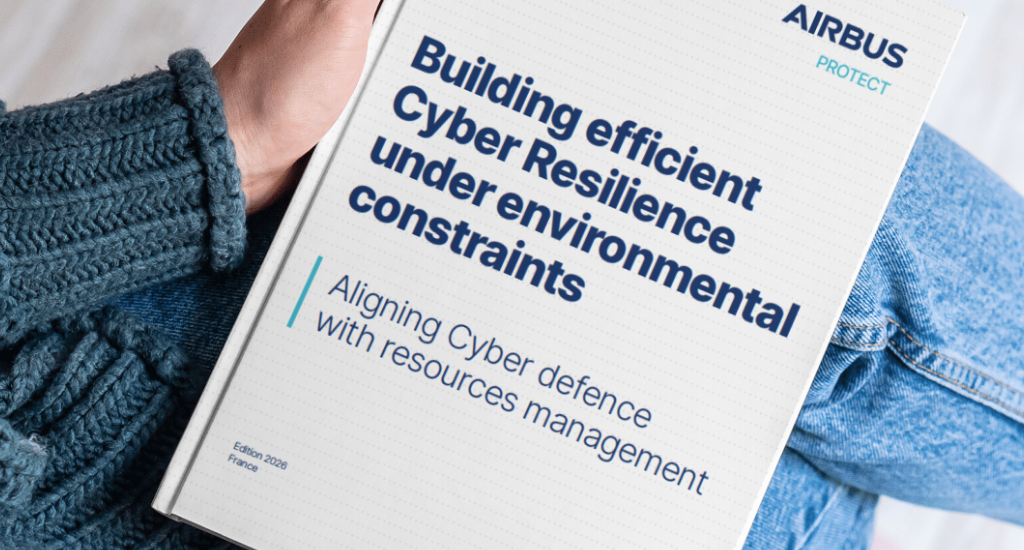
“Why cyber resilience under environmental constraints is critical for your organisation” whitepaper with Airbus Protect

Aligning cyber defense with resource management: building resilient and responsible security operations towards a “frugal cybersecurity” ?

As organisations increase their reliance on digital technologies for cyber threats while pursuing ambitious sustainability goals, they face a growing challenge: how can cybersecurity remain effective while reducing its environmental footprint?

As organisations accelerate their digital transformation, pursue sustainability objectives and adapt to an increasingly uncertain and complex environment, strengthening the resilience of digital infrastructures has become a critical challenge.

Data centres, cloud environments and operational technologies are increasingly exposed to risks such as power shortages, extreme weather events and cooling system failures. These factors can compromise service continuity and create new cybersecurity vulnerabilities.

To address these challenges, Airbus Protect and IRT SystemX joined forces to explore how Security Operations Centres (SOCs) can become compliant with regulations, equally resilient and more resource-efficient.

Their joint study introduces the concept of frugal cybersecurity: an approach that optimises resource consumption without compromising security performance or operational visibility.


A Framework for Sustainable Cybersecurity

The study proposes a structured methodology based on Life Cycle Assessment (LCA) principles applied to cybersecurity operations.

The approach combines operational analysis, environmental impact measurement and optimisation strategies to help organisations better understand the hidden costs of their security infrastructure.


Key areas explored include:

  • Identification of resource-intensive cybersecurity components and operational bottlenecks.
  • Evaluation of environmental impacts such as carbon emissions, water consumption and critical material usage.
  • Assessment of multiple cybersecurity architectures through simulation and digital twin technologies.
  • Optimisation of monitoring capabilities through software efficiency improvements and finer resource management, while exploring future opportunities offered by resource-efficient AI approaches, such as Small Language Models (SLMs). 


What You’ll Learn in the White Paper

This white paper provides practical insights and actionable recommendations for organisations seeking to align cybersecurity resilience with sustainability objectives.

Inside, you’ll discover:

  • How evolving regulations such as NIS2 and CSRD are reshaping cybersecurity and sustainability requirements.
  • A practical methodology for assessing the environmental impact of SOC operations.
  • Real-world examples based on operational data and digital twin simulations.
  • Strategies to optimise data flows, improve resource efficiency and deploy AI models adapted to operational needs.
  • Recommendations for building security operations that are both resilient and environmentally responsible.


An overview before going any further:


Download the white paper co-developed by Airbus Protect and IRT SystemX

* indicates required

By validating this form, I authorize IRT SystemX, Non-profit Scientific Cooperation Foundation, located at 2 Boulevard Thomas Gobert 91120 Palaiseau, France to subscribe me to its mailing list according to my choice above. I may exercise my rights of access, rectification and deletion by writing to communication@irt-systemx.fr. For further information on the use of my data, please consult SystemX policy: https://www.irt-systemx.fr/en/cookies/

We use Mailchimp as our marketing platform. By clicking below to subscribe, you acknowledge that your information will be transferred to Mailchimp for processing. Learn more about Mailchimp’s privacy practices.